The Illusion
ERP is treated as an IT problem
In most Local Governments, ERP responsibility quietly shifts away from the executive table.
It starts logically:
- The system is complex
- It is software
- IT understands technology
So ownership moves to:
- ICT Manager
- ERP/Application Manager
- Project team
At the executive level, attention remains on:
- Budgets
- Council priorities
- Community expectations
- Operational pressures
ERP appears “under control” because:
- Steering committees exist
- Reports are circulated
- Vendors are engaged
From the outside, it looks structured.
But this is the illusion. ERP Is Not an IT Project — It Is Your Operating Engine
The Reality
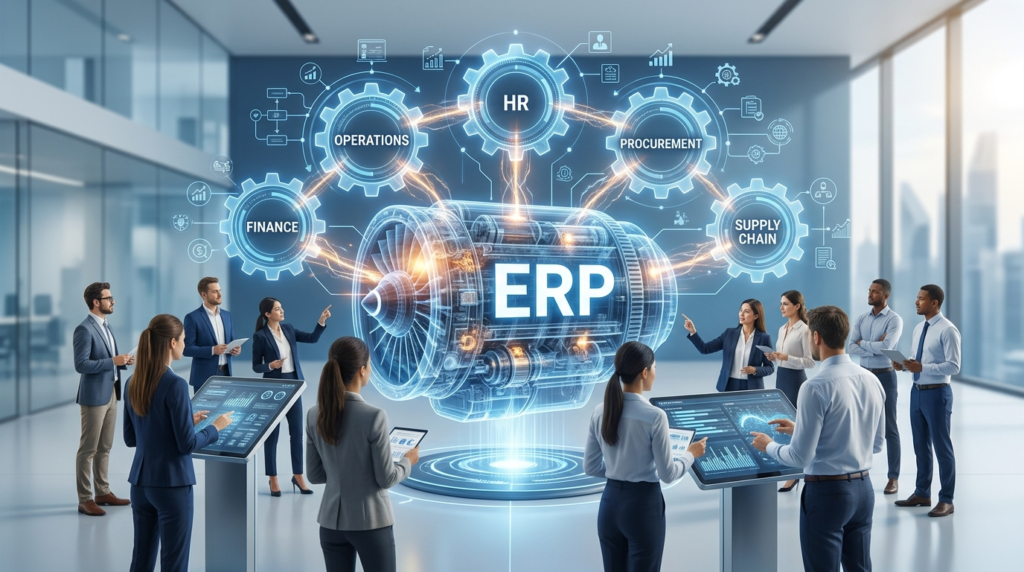
ERP is the organisational engine
Every critical function in your organisation runs through ERP:
- Finance: how money is controlled, reported, and audited
- Procurement: how spend is approved and tracked
- Payroll: how people are paid
- Assets: how infrastructure is managed
- Projects: how work is planned and delivered
ERP is not a system sitting beside the business.
It is the system through which the business operates.
It records:
- Every transaction
- Every approval
- Every decision trail
It defines:
- How work flows
- Where delays occur
- Where controls exist or fail
Example
If your procurement process is inefficient:
- Delays are not just process issues
- They are embedded in ERP workflows
If your financial reporting is unreliable:
- It is not just a reporting issue
- It is a data integrity issue inside ERP
If payroll errors occur:
- It is not just HR
- It is how the system is configured and governed
ERP is the engine.
Everything else is a reflection of how well that engine runs.
The Consequence
Structural underperformance
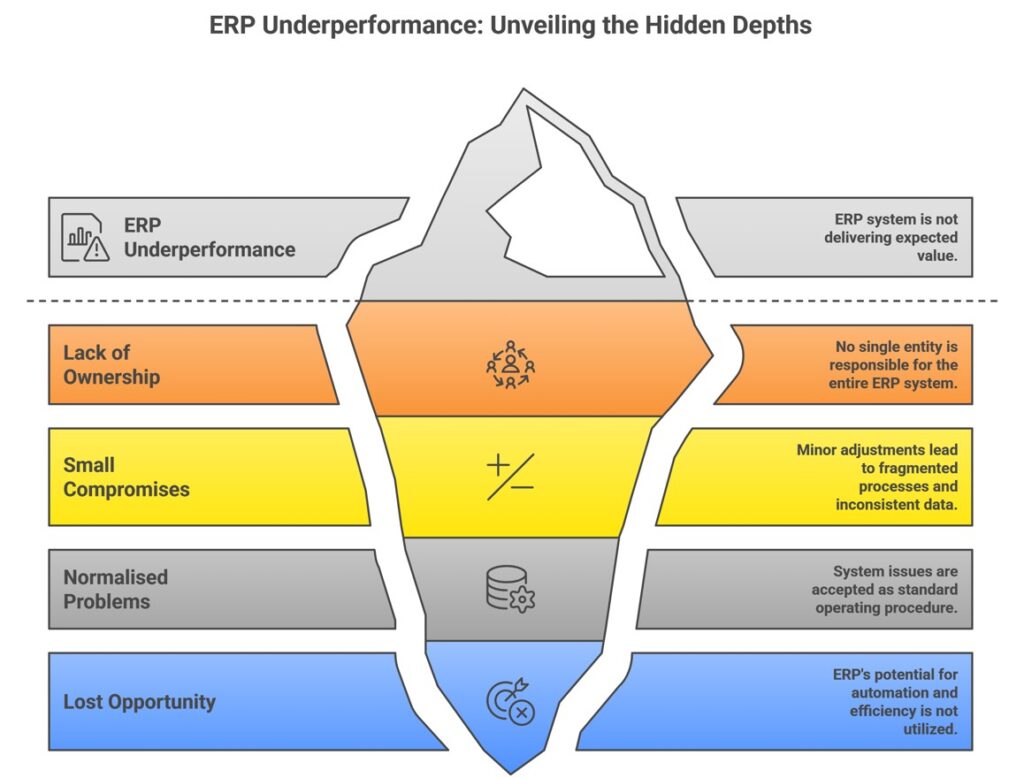
When ERP is treated as an IT project instead of an organisational engine, a consistent pattern emerges.
1. Decisions are made without full ownership
Directors make process decisions.
IT configures the system.
Vendors guide design.
No one owns the whole system outcome.
2. Small compromises accumulate
Each decision seems reasonable in isolation:
- “Let’s customise this”
- “We’ll fix that later”
- “The business needs it this way”
Over time, this creates:
- Fragmented processes
- Inconsistent data
- Reduced transparency
3. Problems become normalised
You begin to hear:
- “That’s just how the system works”
- “Reports need manual adjustment”
- “We rely on spreadsheets for accuracy”
These are not minor issues.
They are signals that the engine is misaligned.
4. Opportunity is lost
ERP is capable of:
- Automation
- Real-time visibility
- Standardisation
- Efficiency at scale
But instead, organisations operate with:
- Workarounds
- Manual intervention
- Delayed insights
The system is live, but the value is not realised.
The Reframe
ERP requires CEO ownership and governance clarity
ERP is not something the CEO needs to “manage day-to-day.”
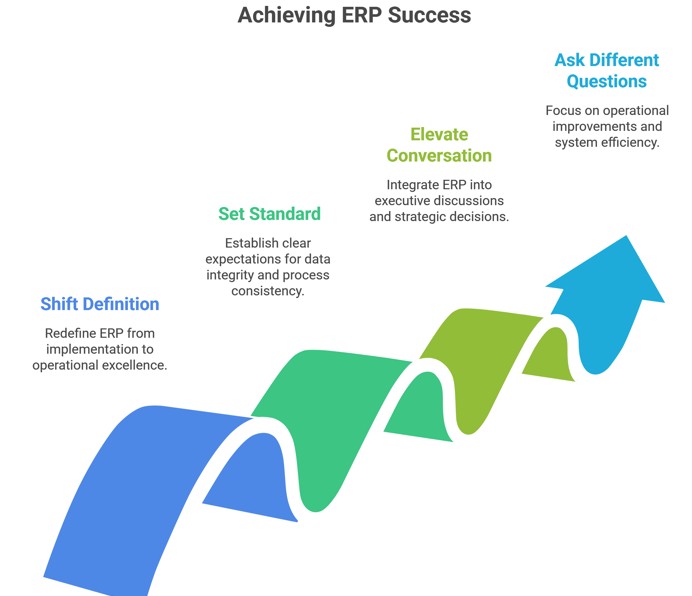
But it is something the CEO must own at a performance level.
This means:
1. Shifting the definition
From:
- “ERP implementation”
To:
- “How our organisation operates”
2. Setting the standard
Clear expectations on:
- Data integrity
- Process consistency
- System adoption
- Reporting accuracy
3. Elevating the conversation
ERP should not only appear in:
- Project updates
- IT reports
It must be visible in:
- Executive discussions
- Performance reviews
- Strategic decisions
4. Asking different questions
Instead of:
- “Is the project on track?”
Ask:
- “Are we improving how the organisation operates?”
- “Do we trust the data we are making decisions on?”
- “Where is the system slowing us down?”
- “What are we still doing outside the system, and why?”
This is where we stuck
This is where most organisations stop — and where problems persist
Recognising the importance of ERP is not enough.
Without a structured way to:
- Monitor performance
- Detect early signals of failure
- Align business and system decisions
- Hold ownership at the right level
The organisation gradually slips back into:
- Delegation
- Fragmentation
- Reactive fixes
This is why leading organisations introduce a governance layer above the project and the system.
A layer that:
- Sees the whole engine
- Connects decisions across business and technology
- Provides early visibility of risk
- Maintains executive control without operational overload
This is the role of an ERP Control Tower.
Not another committee.
Not another report.
A mechanism to ensure that:
the system that runs your organisation is governed at the level it deserves.