How Successful ERP Implementation look like?
What a properly configured, implemented, and embedded ERP actually does
A mature ERP is not a system upgrade. It is an organisational control system—the difference between managing fragments and steering the whole enterprise.
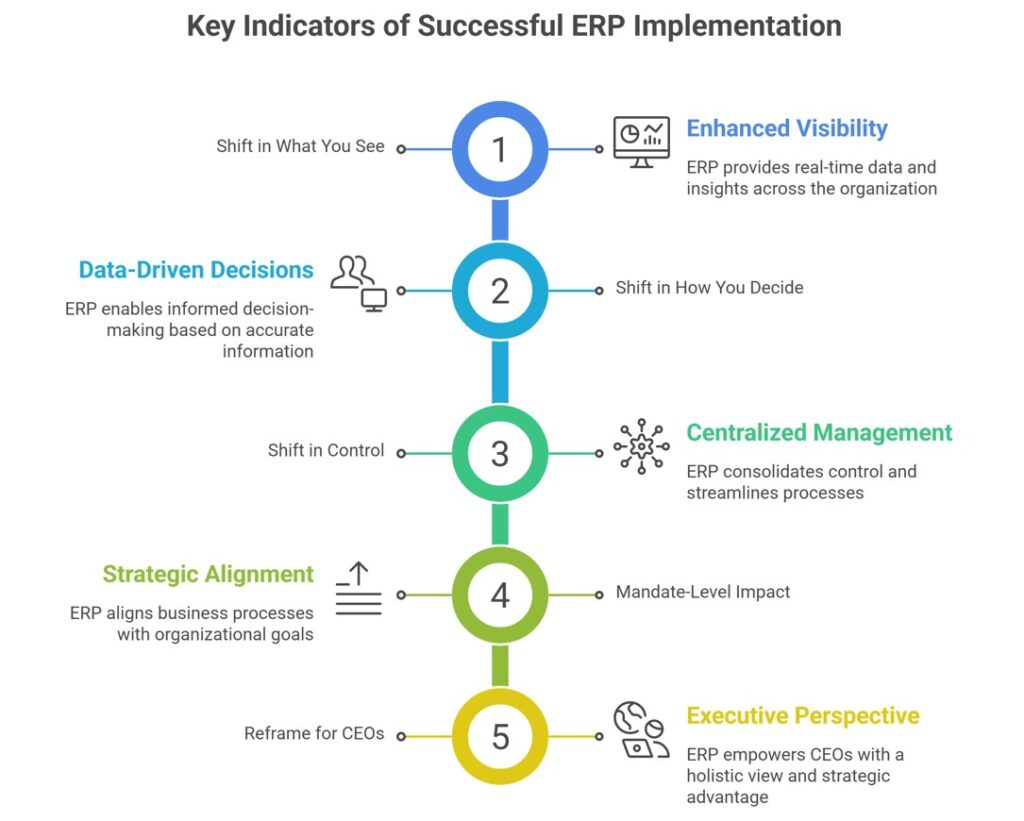
1. The Shift in What You See
Without ERP, a CEO sees reports.
With ERP, a CEO sees the organisation in motion.
Example (Local Government context):
- Instead of waiting for month-end finance packs, you see live financial position:
- Current cash vs committed spend
- Budget burn across departments
- Emerging overruns before they occur
- Instead of siloed capital updates, you see:
- All capital projects across directorates
- Delays, cost drift, and delivery risk in one view
- Instead of HR summaries, you see:
- Vacancy exposure by function
- Overtime pressure
- Workforce cost trends impacting budget
- Instead of reacting to issues, you see:
- Procurement commitments before invoices hit
- Asset failures before they become community issues
- Compliance flags before audit findings
This is not more data.
It is connected visibility.
2. The Shift in How You Decide
Most CEOs spend time validating numbers:
- “Are these figures correct?”
- “Why does Finance say one thing and Operations another?”
A well-embedded ERP removes this friction.
You move to steering priorities:
- Before Council meeting:
- You already know where risks sit
- You already understand budget pressures
- You are not surprised
- During decision-making:
- You act earlier (weeks, not months)
- You decide with confidence, not interpretation
- Across the organisation:
- Everyone is working off the same version of reality
- Less narrative, more evidence
Example:
Instead of debating whether a capital project is “on track,”
you see:
- % completion vs budget
- committed vs actual spend
- delivery risk indicators
The conversation shifts from “What is happening?”
to “What do we do about it?”
3. The Shift in Control
Most organisations operate on personality-based control:
- Strong individuals hold knowledge
- Interpretation drives decisions
- When people leave, clarity disappears
ERP enables institutional control:
- Decisions are grounded in systemic visibility
- Accountability is tied to transparent metrics
- Performance is observable, not arguable
Example:
- Procurement cannot bypass controls because commitments are visible
- Asset risks cannot be hidden because backlog is quantified
- Budget misalignment is visible against the Strategic Community Plan
This reduces reliance on:
- individual capability
- internal politics
- narrative management
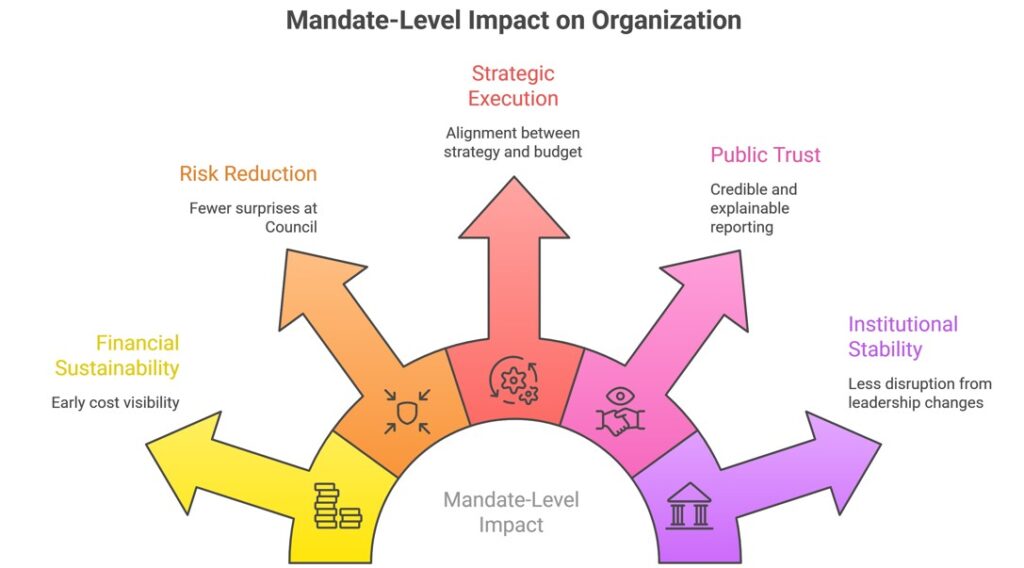
4. The Mandate-Level Impact
When ERP is done properly, the impact is not operational—it is strategic:
Financial Sustainability
- Early visibility of cost pressures
- Reduced leakage through procurement and inefficiencies
Political & Audit Risk Reduction
- Fewer surprises at Council
- Strong audit trails and compliance visibility
Strategic Execution
- Alignment between strategy, budget, and delivery
- Capital and operational priorities stay connected
Public Trust
- Reporting becomes credible
- Numbers are consistent and explainable
Institutional Stability
- Less disruption from leadership changes
- Continuity of decision-making quality
5. The Reframe for CEOs
ERP is often positioned as:
- an IT project
- a finance system
- a back-office upgrade
This is incorrect.
ERP is the mechanism through which you:
- see the organisation clearly
- act earlier
- reduce risk
- execute strategy with precision
6. The Bottom Line
A well-implemented ERP does one thing exceptionally well:
It removes ambiguity from leadership.
And when ambiguity is removed:
- decisions improve
- risk reduces
- performance stabilises
This is not system implementation.
This is executive clarity at scale.
Implication for you as CEO:
If your ERP is not giving you this level of clarity, you do not have an ERP problem.
You have a governance and configuration problem.