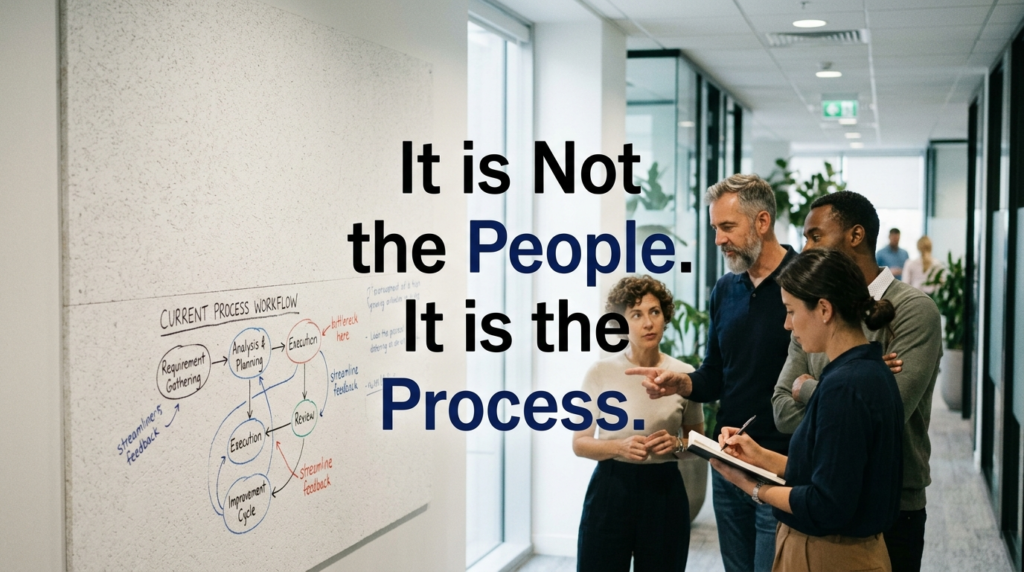
Most leaders, when something goes wrong, look for a person to blame or a decision to reverse.
The project is over budget — find the project manager who missed the signals. The system went live and users hate it — blame the vendor. The team keeps failing despite working harder than ever — replace someone.
We are extraordinarily good at diagnosing symptoms. We are remarkably bad at finding causes.
The cause is almost always the process. Not the person. Not the technology. Not the budget. The process — or more precisely, the absence of one.
We Don’t Take Process Seriously
A council goes live on a new finance system. Within six months, the finance team is running parallel spreadsheets, reconciling manually, and working weekends. Leadership calls it a “change management problem” and sends everyone on a training course.
The training course changes nothing.
What actually happened: nobody designed the process for how transactions would flow from departments to finance under the new system. The old informal workarounds — the phone calls, the email chains, the end-of-month heroics — had been the process. The ERP assumed a clean structured flow that had never existed. Training people on software doesn’t fix a broken process underneath it.
This pattern repeats constantly. An Aboriginal corporation runs a capital works program. The board gets monthly updates. Every update says the program is on track. Then, at month seven of a twelve-month program, sixty percent of the work is still incomplete. How?
Because there was no process for how progress was actually measured. The project manager was reporting effort — hours worked, meetings held, contractors engaged. Not outcomes. Not milestones against a delivery schedule. Brute force and goodwill had been substituted for a tracking process. It looked fine until it didn’t.
Hard Work Is Not a Process
This is the pattern that costs organisations the most.
Something isn’t working. The team applies more effort. Longer hours, more meetings, more people pulled in. Resources exhaust. The problem persists — sometimes worsens. Leadership concludes the team lacks capability.
But effort applied without process is just accelerated resource consumption. You run faster in the wrong direction.
A construction company tendering for government work keeps losing bids. Their pricing team works harder each cycle — more detailed costings, more competitive rates, more time spent. They keep losing. When someone finally maps the tendering process end-to-end, it turns out their bid submissions consistently miss two evaluation criteria that assessors weight heavily. Nobody had ever read the evaluation framework carefully. The process for preparing bids had never been formally designed. Everyone was working from habit and assumption.
The problem wasn’t effort. It was never effort.
Competence Includes Process
There is a defence leaders reach for here: “This is a competence issue. We need better people.”
Sometimes that’s true. But consider what competence actually means in practice.
A competent finance director doesn’t just understand accounting. They understand the process by which financial information flows through their organisation — where it originates, where it gets touched, where errors enter, what controls exist. They can see the system, not just the numbers.
A competent project sponsor doesn’t just attend steering committees. They understand the process by which their program produces decisions — who has authority at what threshold, how risks escalate, what triggers a pause versus a push-through. They can read the program’s health, not just its reports.
Knowing the right process and being able to implement it — that is competence. The two cannot be separated.
When a capable person is dropped into a broken process, the process wins. Every time.
The Leverage Is in the Process
Here is what changes when leaders understand this.
You stop diagnosing people and start diagnosing systems. You ask different questions. Not “who dropped the ball?” but “what should have happened at that step, and what actually happened?” Not “why isn’t the team performing?” but “what does the process assume about how this team operates, and is that assumption true?”
You also get genuine leverage. A process can be changed. A single process improvement — a clear escalation path, a properly defined milestone, a structured handoff between teams — can resolve a problem that months of additional effort could not.
This is why the good news is real: most process problems are solvable. The processes for running ERP programs, managing capital works, structuring governance, onboarding systems — they are known. Tried and tested across hundreds of organisations. You do not need to invent them.
What you need is someone who can see the gap between the process that should exist and the process that actually does — and close it.
Three Questions Worth Asking Now
If your organisation is experiencing constant effort without proportionate results, ask these:
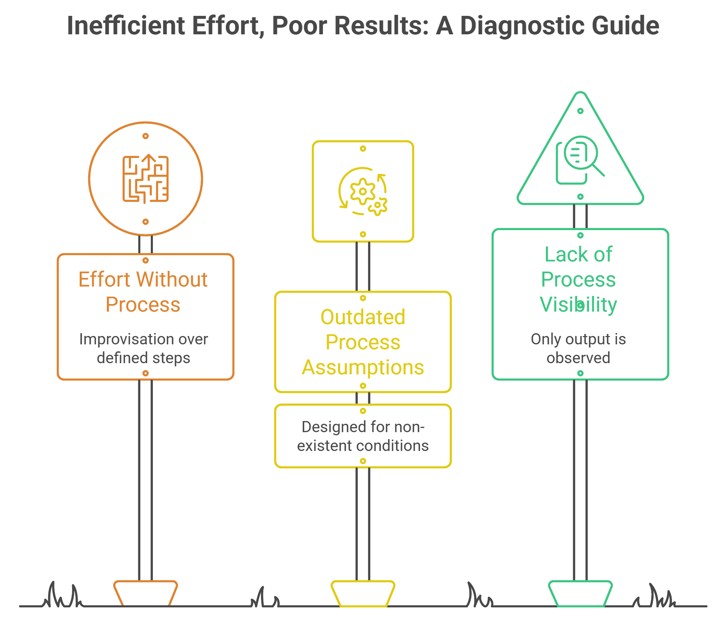
- Where are we substituting effort for process? Identify the areas where the team is working hardest. Ask whether there is a defined process underneath that effort or whether individuals are improvising.
- What does our process assume that may not be true? Most broken processes fail not because they were poorly designed but because they were designed for conditions that no longer exist — or never existed.
- Who in this organisation can see the process, not just the output? Every organisation needs someone with enough distance and enough experience to diagnose the system rather than the symptoms.
The problem, in most cases, is not the people.
It is the process they are operating inside — and the fact that nobody has looked at it clearly in a long time.
SP Singh is an independent ERP advisor and program oversight specialist. He works with WA local government and Aboriginal corporations to identify what’s drifting in their technology programs before the cost of correction becomes too high. bhaniconsulting.com