The Economy Runs on Our Pain. That’s Not an Accident.
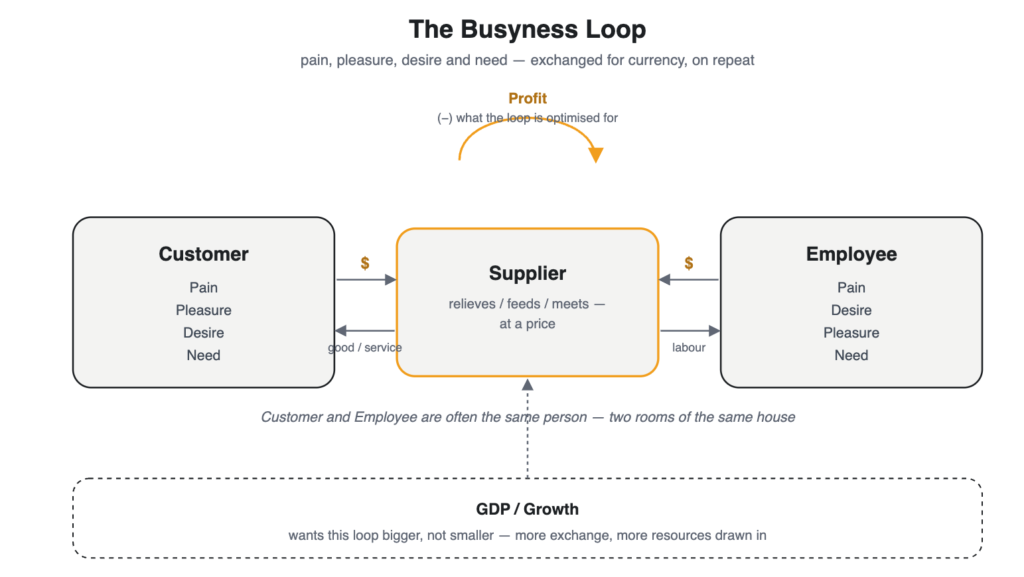
A customer carries pain, pleasure, desire, need. A supplier sits in the middle. An employee — who is also, somewhere else in their life, a customer — carries the same four things. Currency moves from customer to supplier. Currency moves from supplier to employee. Somewhere in that loop, a small arrow points up: profit. The loop resets. Everyone goes back to being busy.
That’s the whole machine. Pain gets relieved, pleasure gets fed, desire gets chased, need gets met — and currency changes hands every time. The exchange is not incidental to the system. It is the system. And the busier that exchange gets, the more the machine likes it.
Look at where this shows up in daily life once you know what you’re looking at.
Pain manufactured, then sold back to you. Your shoulders hurt from twelve hours at a desk. A market exists to sell you the chair, the physio session, the massage gun, the app that reminds you to stretch. Nobody in that chain is lying to you — the pain is real, the relief is real. But notice: the same economy that produced the desk-bound job also produces the industry that treats its damage. Two exchanges of currency, one root cause. That’s not a conspiracy. It’s just what a system optimised for exchange does with a problem — it turns it into two markets instead of fixing one.
Desire manufactured on a schedule. You didn’t wake up needing a new phone. The phone you have works. But a cycle exists — announcement, comparison, slight inadequacy, purchase — and it repeats every year almost to the day. Fashion runs the same loop twice a year. Software runs it as “upgrades.” None of this is hidden. It’s printed in the quarterly results as growth.
The employee side of the same loop. You take the job to earn the currency to relieve your own pain and chase your own desire. But the job itself generates new pain — stress, time scarcity, distance from family — which creates new desire — the holiday, the shortcut, the convenience purchase — which requires more currency, which requires more hours at the job. The employee and the customer are the same person, standing in two different rooms of the same house, and the house is designed so neither room’s door quite closes.
And GDP wants all of this to keep growing. Growth, measured the way we measure it, is the sum of all these exchanges getting bigger. Not necessarily the sum of pain relieved or need actually met — the sum of currency moved. A government measured on GDP has a structural interest in pain, pleasure, desire and need expanding, not shrinking. More exchange. More activity. More resources pulled out of the ground to feed it. Prosperity and progress become the words we use to make this expansion feel virtuous rather than merely convenient — convenient for whoever sits at the profit arrow in the diagram, less obviously convenient for whoever is standing in the loop generating the currency.
None of this makes the loop evil. Markets relieve real pain and meet real need — that part is not in question. What’s worth sitting with is narrower: how much of your own busyness this week was you meeting a need, and how much of it was the loop manufacturing one for you to meet. Those two things feel identical from inside a Tuesday. They are not identical in what they cost you.
The diagram doesn’t have an exit arrow. That’s the part worth noticing before you decide whether it needs one.