Why ERP Initiatives Underperform — Starting at the Root Cause
ERP initiatives do not fail because of technology.
They underperform because of a more fundamental issue:
A lack of understanding of what ERP actually is—and what it demands from the organisation.
Everything that follows stems from this.
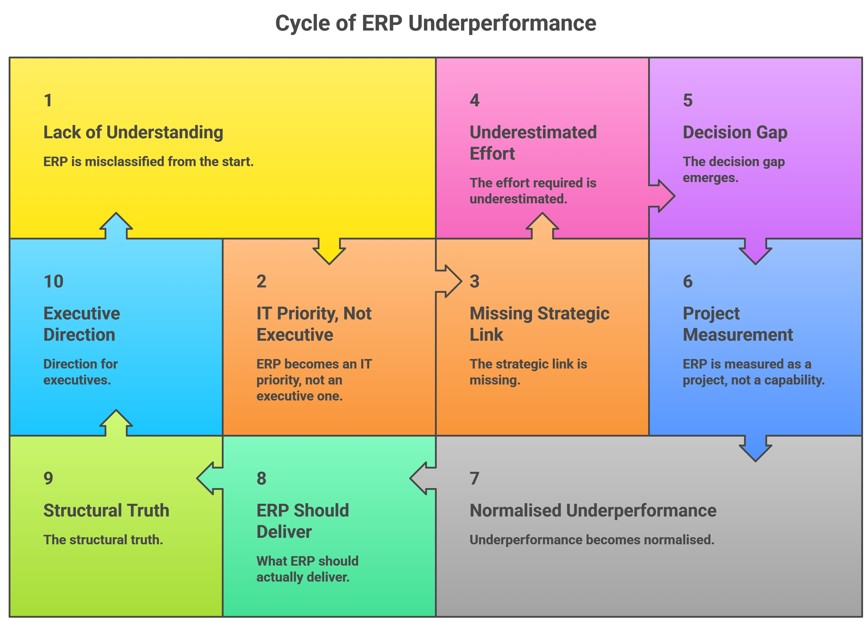
1. Lack of Understanding: ERP Is Misclassified from the Start
Most organisations begin with an incomplete mental model.
ERP is seen as:
- A system replacement
- A finance upgrade
- An IT-led initiative
Instead of what it truly is:
- A design of how the organisation operates
- A control system for financial, operational, and service performance
- A foundation for decision-making across the enterprise
Because this is not fully understood:
- The scope is framed incorrectly
- The effort is underestimated
- The ownership is misplaced
This initial misclassification shapes every downstream decision.
2. ERP Becomes an IT Priority, Not an Executive One
Once ERP is misunderstood, it is naturally delegated.
It moves from:
- Executive ownership
To:
- IT and project teams
This creates a structural shift:
- Executives stay informed—but not deeply engaged
- Strategic intent is not actively governed
- Trade-offs are made without enterprise-wide visibility
ERP continues to progress—but without executive gravity.
Over time, this leads to:
- Fragmented decision-making
- Local optimisation over enterprise design
- Reduced accountability at the top
3. The Strategic Link Is Missing
Because ERP is not understood as a strategic system, it is not properly linked to:
- Business strategy
- Service delivery model
- Business architecture
- Systems architecture
Instead, implementation focuses on:
- Requirements gathering
- Configuration
- Module delivery
What is missing is the question:
“How should this organisation fundamentally operate—and how will ERP enforce that?”
Without this:
- The system reflects existing inconsistencies
- Inefficiencies are digitised instead of removed
- Variability is preserved instead of standardised
4. The Effort Required Is Underestimated
When ERP is treated as a system project, critical components are undervalued:
- Change management
- Data ownership and migration
- Process standardisation
- Training and behavioural adoption
- Governance discipline
These are not side activities.
They are the core of ERP success.
When underestimated:
- The system is delivered
- The organisation is not ready
This results in:
- Workarounds
- Low adoption
- Continued reliance on manual processes
5. The Decision Gap Emerges
At the executive level:
- Strategy is defined
- Outcomes are agreed
At the delivery level:
- Daily configuration decisions are made
- Trade-offs are accepted
- Constraints are worked around
Between these layers, a gap forms.
Over time:
- Decisions drift away from strategic intent
- Small compromises accumulate
- The system evolves differently than planned
No single decision causes failure.
But collectively:
- The design integrity is lost
This gap also creates:
- Limited visibility for executives
- Plausible deniability
- Difficulty assigning accountability
6. ERP Is Measured as a Project, Not a Capability
Because of the initial misunderstanding, success is measured using:
- Time
- Budget
- Go-live status
These metrics answer:
“Did we deliver the system?”
But not:
“Did we improve how the organisation performs?”
As a result:
- ERP can be declared successful
- While operational performance remains unchanged
Success becomes a narrative shaped by delivery constraints, not outcomes.
7. Underperformance Becomes Normalised
As challenges emerge:
- Expectations are adjusted
- Trade-offs are rationalised
- Outcomes are reframed
Not intentionally—but structurally.
Because:
- Too much has been invested
- Reversing course is difficult
- Accountability is diffused
The organisation settles into:
“This is acceptable given the circumstances.”
At this point:
- Underperformance is embedded
- Improvement becomes incremental, not structural
8. What ERP Should Actually Deliver
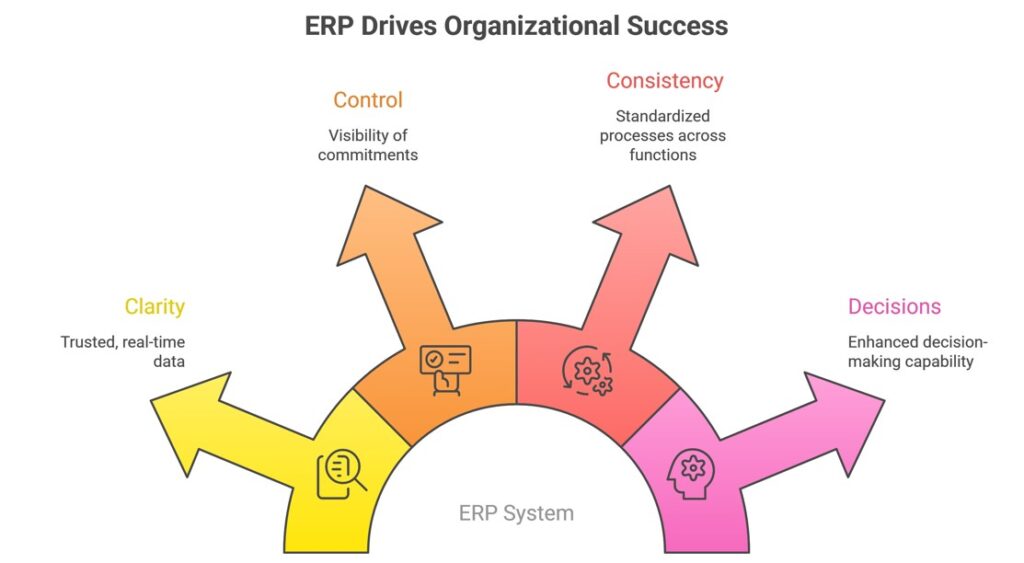
When properly understood and governed, ERP enables:
Organisational Clarity
- Trusted, real-time data
- Single source of truth
Control
- Visibility of commitments before spend
- Early identification of risk
Consistency
- Standardised processes across functions
- Reduced reliance on individuals
Decision Capability
- Faster, more confident executive decisions
- Alignment between strategy and operations
This is not a system outcome.
It is a governance and capability outcome.
9. The Structural Truth
ERP underperformance is not caused by:
- The vendor
- The software
- The project team
It is caused by:
The organisation not being structured to understand, govern, and absorb ERP as a capability
At its core:
- Executive standards are unclear
- Ownership is fragmented
- Decisions are not aligned to intent
This aligns directly with the deeper pattern:
ERP underperformance is driven by Executive Standard Ambiguity, not execution failure
10. Direction for Executives
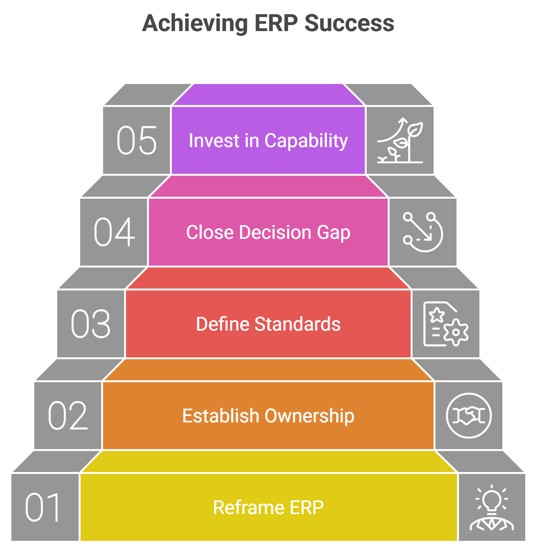
1. Reframe ERP Immediately
Treat ERP as:
- An organisational control system
- A capability platform
Not: - A technology project
2. Establish Executive Ownership
- ERP must sit at CEO and executive level
- Not delegated as an IT responsibility
3. Define the Standard Explicitly
Clarify:
- What “good” looks like for data, processes, and reporting
- What cannot be compromised
Without this:
- The organisation defaults to inconsistency
4. Close the Decision Gap
- Elevate critical design decisions
- Make trade-offs visible
- Ensure alignment between strategy and execution
5. Invest in Capability, Not Just Delivery
- Build internal ownership of processes and data
- Strengthen governance structures
- Treat post-go-live as the beginning, not the end
Final Position
ERP does not fail because organisations make poor decisions.
It underperforms because:
They do not fully understand the nature of the system they are implementing
Until that understanding shifts:
- The same patterns will repeat
- Across systems, vendors, and projects
The leverage point is not technology.
It is how the organisation thinks, governs, and defines its standards.