Why ERP Programs Become Messy
Two years into an ERP program, the reports still look acceptable.
Milestones are being tracked.
Steering committees are meeting.
Vendors are presenting progress.
Nothing appears out of control.
And yet—something feels off.
Decisions are harder than they should be.
Conversations are longer but less conclusive.
Confidence is quietly eroding.
At the executive level, this is often the first signal:
The program is not failing visibly — it is drifting structurally.
The Dynamic: A Multi-Player System Without a Shared Game
ERP programs are not just delivery efforts.
They are multi-player systems, where each group operates with different incentives, constraints, and definitions of success.
On paper, everyone is aligned.
In reality, each stakeholder is playing a different game.
- The vendor is optimising for delivery scope and commercial return
- The internal project team is managing risk and continuity of employment
- Business leaders are protecting operations and minimising disruption
- Executives are balancing political, financial, and reputational pressures
None of these are wrong.
But they are not aligned.
What It Feels Like at the Executive Level
This misalignment does not present as a single failure.
It shows up as friction.
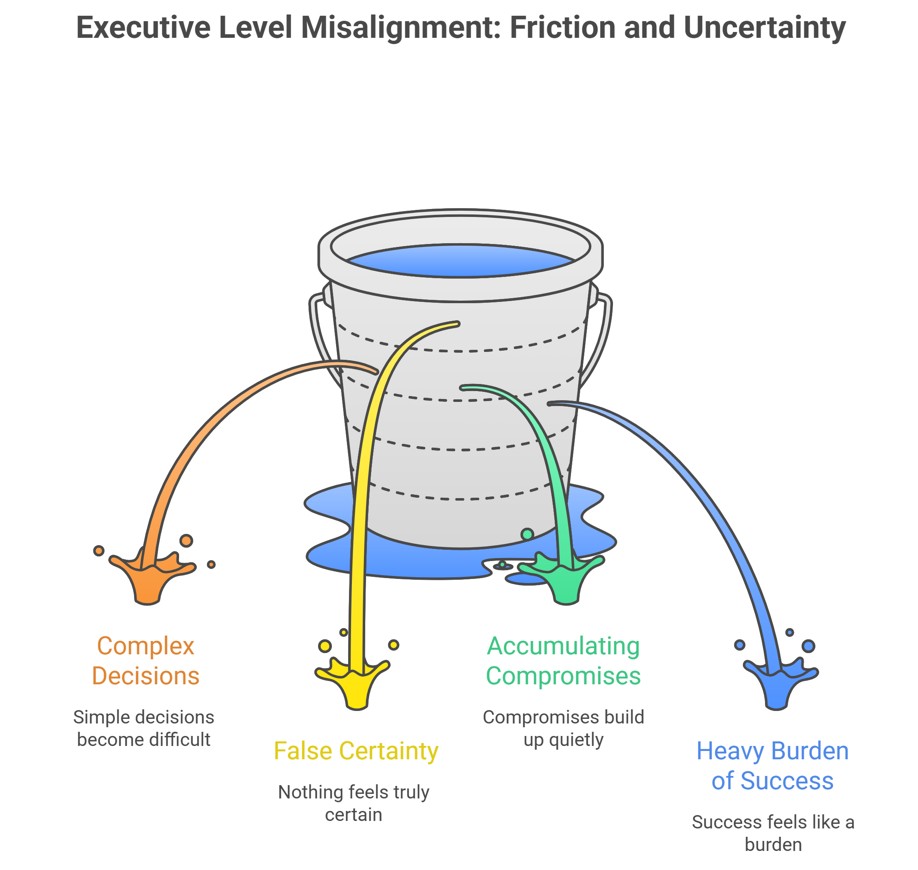
1. Decisions That Should Be Simple… Aren’t
An executive asks:
“Should we standardise this process or customise it?”
The room responds with:
- “It depends”
- “We need more workshops”
- “The system can handle both”
Weeks pass. No clear direction.
What is actually happening:
- Vendor prefers complexity (more effort, more revenue)
- Business prefers customisation (less disruption)
- Project team avoids committing (risk containment)
The decision is not technical.
It is structurally conflicted.
2. Everything Is “On Track”… But Nothing Feels Certain
Reports show green.
But:
- Issues are being reframed, not resolved
- Trade-offs are being deferred
- Risks are being absorbed into scope
Executives sense it:
“We are moving, but are we getting closer to the right outcome?”
This is where perception and reality begin to diverge.
3. Compromises Start Accumulating Quietly
No single decision is wrong.
But collectively:
- Processes are partially standardised
- Data structures are inconsistently defined
- Workarounds are accepted “for now”
Each compromise is reasonable in isolation.
Together, they form a system that is:
Delivered successfully, but operationally compromised.
4. The Burden of “Success” Becomes Heavy
As the program progresses, a subtle shift occurs.
The goal is no longer:
Deliver the right system
It becomes:
Deliver something that can be called a success
At this point:
- Escalations reduce
- Challenges are softened
- Narratives are managed
Executives feel it as tension:
“Are we solving the problem, or managing the story?”
Why This Happens
Because the program is operating without a unified definition of success and aligned incentives.
In this environment:
- Governance becomes reporting-focused, not decision-focused
- Trade-offs remain implicit, not explicit
- Accountability is distributed, but ownership is unclear
The result is predictable:
Misalignment → Distorted decisions → Compromised design → Managed success narrative
The Structural Problem: No One Owns the Whole Outcome
ERP programs often have:
- Project governance
- Technical governance
- Change governance
But what is missing is:
Value governance at the executive level
No single structure ensures that:
- Decisions align to long-term organisational value
- Trade-offs are made consciously and consistently
- Incentives across stakeholders are aligned
Without this, the system self-optimises… in different directions.
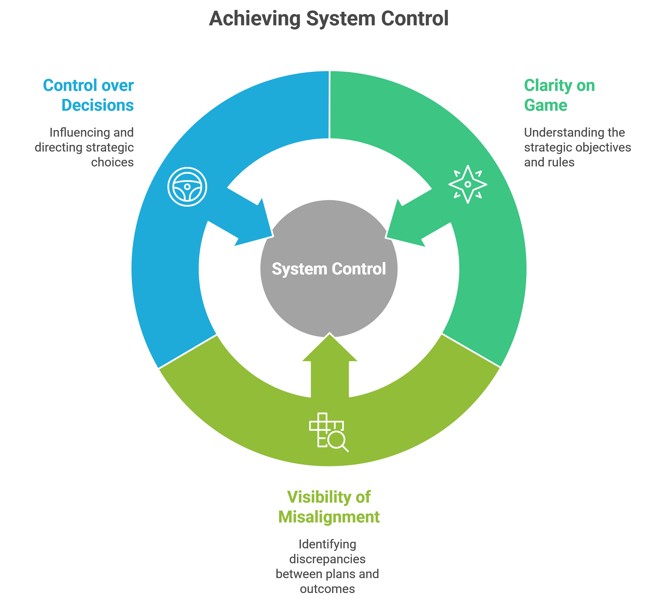
The Shift Required: From Delivery Oversight to System Control
Executives do not need more reports.
They need:
- Clarity on what game is being played
- Visibility of where misalignment exists
- Control over how decisions are made
This is where a different model is required.
Introducing the ERP Control Tower™
The ERP Control Tower™ is not another governance layer.
It is a control mechanism for alignment.
Its purpose is to ensure that:
The entire system operates toward a single definition of success.
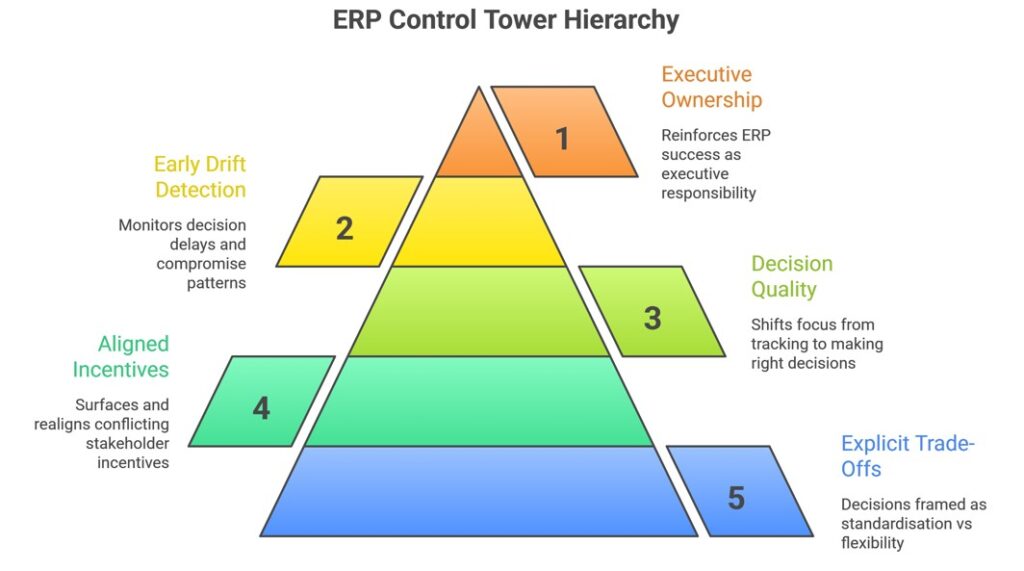
What the Control Tower Changes
1. Makes Trade-Offs Explicit
Every major decision is framed as a trade-off:
- Standardisation vs flexibility
- Speed vs quality
- Cost vs long-term value
Executives are not shielded from these—they are guided through them.
2. Aligns Incentives Across Stakeholders
The Control Tower surfaces:
- What each party is optimising for
- Where those incentives conflict
- What needs to be realigned
This turns hidden tension into visible structure.
3. Shifts Governance from Reporting to Decision Quality
Instead of asking:
“Are we on track?”
It asks:
“Are we making the right decisions?”
This changes the entire posture of the program.
4. Provides Early Detection of Drift
Rather than waiting for failure signals (budget, timeline), it monitors:
- Decision delays
- Compromise patterns
- Escalation avoidance
These are early indicators of structural misalignment.
5. Re-establishes Executive Ownership
Most importantly, it reinforces that:
ERP success is not a project outcome — it is an executive responsibility
The Control Tower gives executives the mechanism to fulfil that responsibility.
What This Means in Practice
When the Control Tower is in place:
- Decisions are faster, because trade-offs are clear
- Conversations are sharper, because incentives are visible
- Compromises are deliberate, not accidental
- Success is defined upfront—and defended throughout
The program stops feeling “messy”.
Because it is no longer a collection of competing agendas.
It becomes a coordinated system.
Final Thought
ERP programs do not become messy overnight.
They drift—quietly, structurally, predictably.
Executives often feel it long before it is visible.
The question is not:
“Is the project on track?”
The real question is:
“Is the system aligned?”
Because if it is not,
no amount of reporting will fix it.
Only control will.
Reach out to us at info@bhaniconsulting.com- if you’d like to know more.