It Looks Simple—Until You Look Closer
From the outside, an organisation looks straightforward.
There is:
- A structure
- A system
- A team of people doing their jobs
Everything appears organised.
You would expect it to work smoothly.
But then questions start to appear:
- Why do decisions feel inconsistent?
- Why do systems not deliver expected value?
- Why does progress feel harder than it should be?
Nothing is obviously broken.
And yet, something is not quite right.
To understand this, we need to look at the organisation in a simpler way.
Imagine It Like a Playground
Think of an organisation like a playground.
There are:
- Children playing
- Rules written on a board
- Equipment designed for play
At first glance, everything is set up correctly.
But if you watch closely, something interesting happens.
Not all children play the same game.
Different Games, Different Goals
Some children want to win.
Some want to have fun.
Some want to avoid getting hurt.
Some just want to finish quickly and leave.
They are all in the same playground.
But they are not playing the same game.
Now bring this back to an organisation.
Your Organisation Is an Ecosystem
Your organisation is surrounded by different players:
- Board
- Executives
- Regulators
- Government
- Suppliers
- Employees
- Auditors
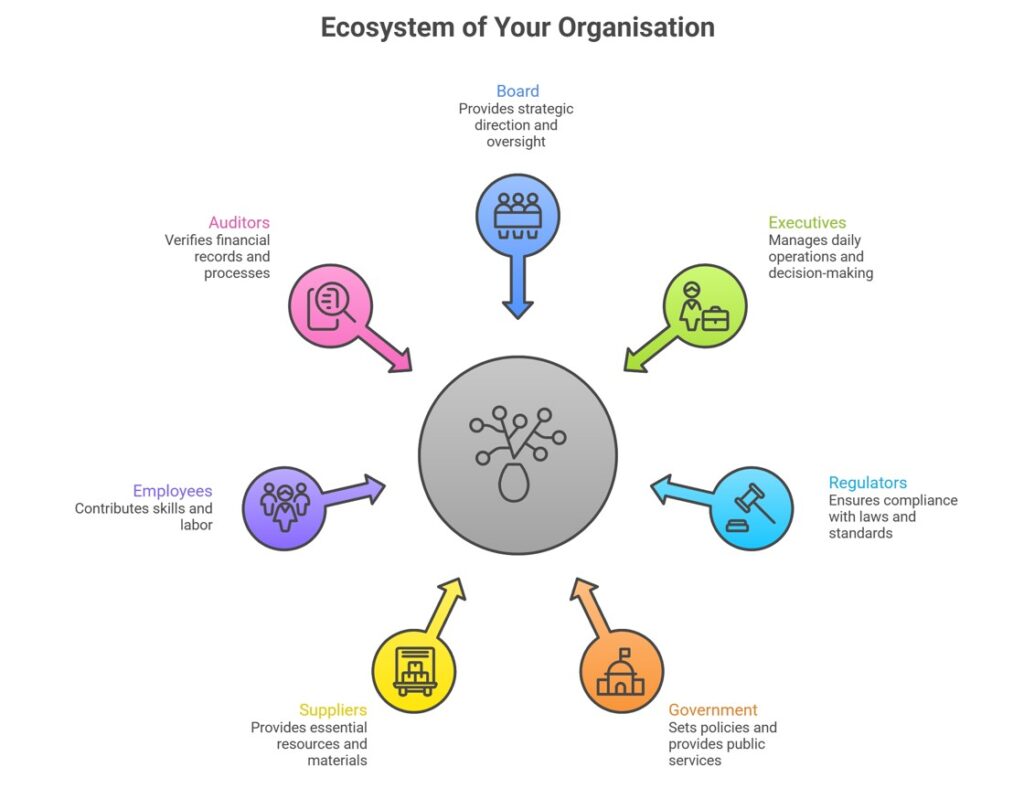
Each one is part of the same environment.
But each one has different objectives.
- Regulators want compliance
- Finance wants control
- Operations want speed
- Suppliers want efficiency
- Executives want outcomes
Everyone is involved. But not everyone is aiming at the same thing.
And These Objectives Don’t Always Align
Sometimes they align.
Often, they don’t.
- What speeds up delivery may reduce control
- What improves compliance may slow operations
- What benefits one team may create friction for another
This is where complexity begins.
Not in systems.
Not in structure.
But in competing objectives.
Now Bring It Inside the Organisation
Inside this ecosystem, the organisation tries to bring order.
It does this using two things:
Structure
This defines:
- Who does what
- Who reports to whom
- What rules should be followed
System
This enables:
- Workflows
- Transactions
- Reporting
- Day-to-day operations
Together, structure and system are meant to create clarity.
But Here Is What We Miss
We assume:
If structure is clear and systems are in place—the organisation will work as expected.
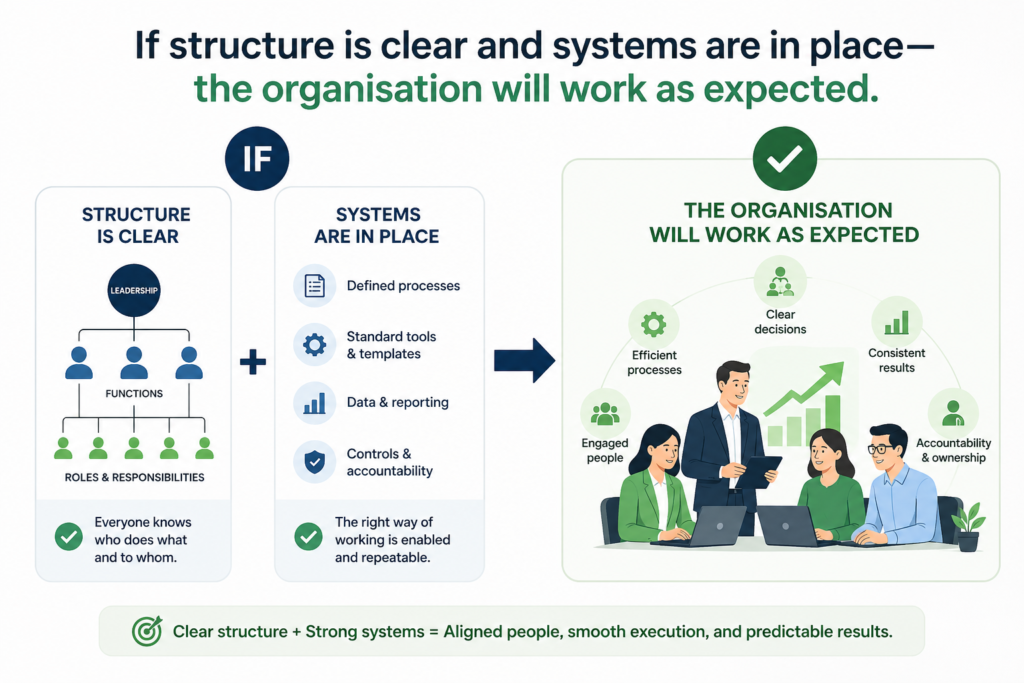
But this assumption ignores something important.
People Don’t Follow Systems—They Play Their Own Game
Just like the children in the playground, people in organisations:
- Adapt
- Optimise
- Work around constraints
They respond to:
- Pressure
- Incentives
- Time constraints
- Personal goals
So even with:
- Clear structure
- Strong systems
People will still:
- Take shortcuts
- Find faster ways
- Prioritise what matters to them
This Is Where Things Start to Drift
Now you have:
- An ecosystem with different objectives
- An organisation with defined structure
- Systems designed to control work
- People responding to real-world pressures
These do not automatically align.
So what happens?
- Systems are used differently than intended
- Processes are followed sometimes, not always
- Decisions vary depending on context
From the outside: Everything still looks fine.
From the inside: It feels harder than it should be.
The Real Role of Executive Management
This is where leadership becomes critical.
The role of executive management is not just to:
- Approve decisions
- Review reports
- Drive performance
The real role is:
To create awareness and alignment across all these different “games.”
This means:
- Understanding who wants what
- Recognising where objectives conflict
- Making trade-offs explicit
- Aligning structure, systems, and behaviour
Why This Is So Difficult
Because much of this is not visible.
You can see:
- Org charts
- Systems
- Reports
But you cannot easily see:
- Incentives
- Informal decisions
- Workarounds
- Hidden pressures
And what is not visible—is rarely managed.
A Simple Way to Think About It
Think of your organisation as three things happening at once:
- A system that processes work
- A structure that defines rules
- An ecosystem of players with different goals
And within all of this:
People are constantly adjusting to make things work.
Why Organisations Feel Hard
Organisations are not hard because they are broken.
They are hard because:
Multiple players are playing different games within the same system.
And no one is fully aligning them.
Closing Thought
Most organisations try to improve by:
- Changing systems
- Updating structure
Very few focus on:
Understanding and aligning the different objectives and behaviours at play
Until this is addressed:
- Complexity will remain
- Effort will increase
- Outcomes will vary
Not because people are failing—but because the organisation is not designed to align how it actually works.
If you can start to see this clearly, you begin to move from:
Managing parts of the organisation
to
Understanding the organisation as a whole.