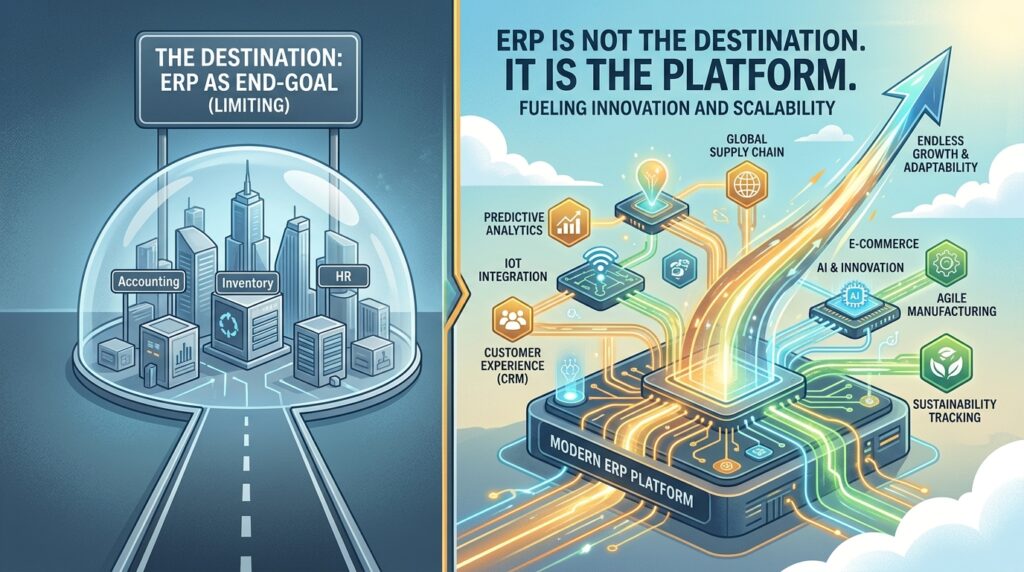
Most organisations believe ERP success is achieved at go-live.
The system is implemented.
Users are trained.
Reports are running.
On paper, the project is complete.
But in reality, this is where the real work begins.
And this is where most organisations quietly stop. Note that ERP is not the project; here’s why!
The Problem No One Calls Out
ERP programs are treated as projects to deliver, not capabilities to build.
So the focus becomes:
- Timeline
- Budget
- Configuration
- Go-live
And once those are achieved, attention shifts elsewhere.
What gets missed is far more important:
- How the organisation actually works with the system
- Whether processes are improving
- Whether decisions are getting better
- Whether value is being realised from the investment
The result?
A system that exists — but does not transform.
The Reality: ERP Maturity Happens in Stages
ERP is not a binary outcome (implemented vs not implemented).
It is a progression of maturity.
And each stage requires a fundamentally different mindset.
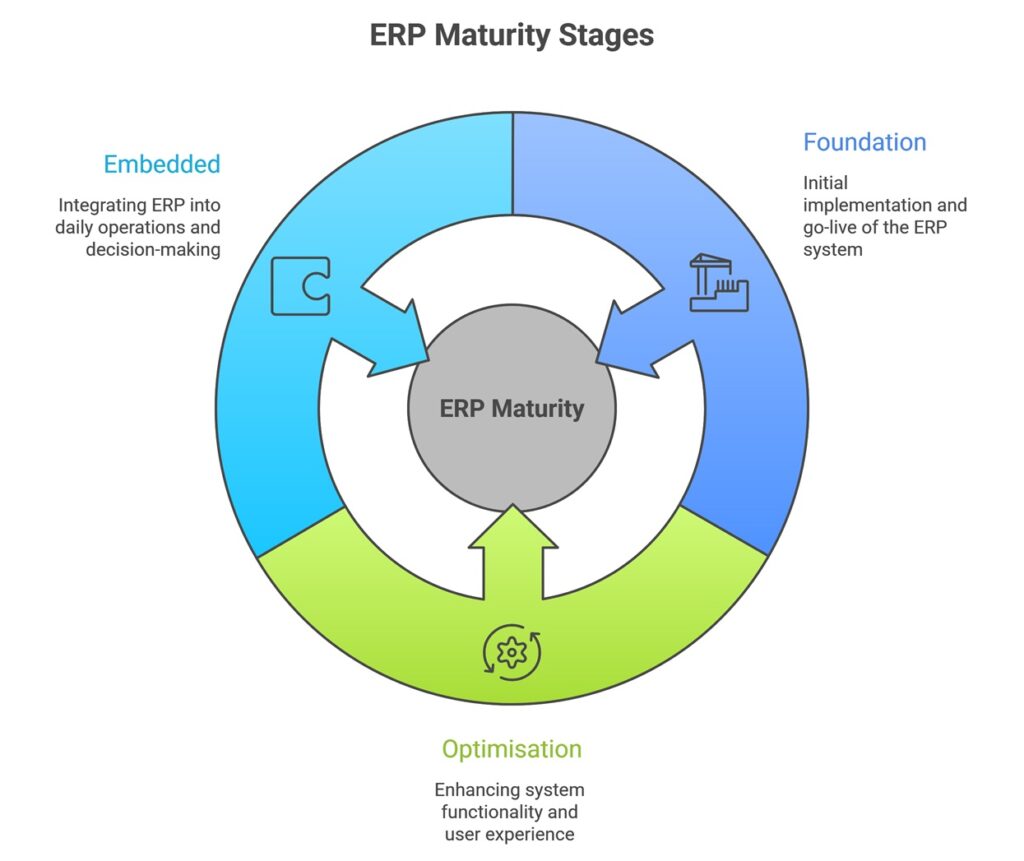
Stage 1 – Foundation (Getting to Go-Live)
This is where most energy is spent.
The organisation focuses on:
- Configuration and data migration
- Basic workflows
- Minimal customisation
- Basic security roles
- Limited integrations
The goal is simple:
Make the system work.
And when go-live happens, it feels like success.
But this stage only delivers one thing:
System availability — not business value.
Stage 2 – Optimisation (Making It Useful)
This is where ERP starts to matter.
The organisation begins to:
- Integrate systems
- Refine workflows
- Develop SOPs and training
- Improve reporting and dashboards
- Identify bottlenecks and inefficiencies
- Tailor the system to real operational needs
Now the question shifts from:
“Is the system working?”
to
“Is the organisation working better because of the system?”
This stage delivers:
Efficiency, visibility, and improved decision-making.
Yet many organisations only partially reach this stage.
Because optimisation requires ownership.
And ownership is often unclear.
Stage 3 – Embedded (Making It Valuable)
Very few organisations reach this stage.
This is where ERP becomes part of the organisation’s DNA.
At this level:
- Systems, processes, and data are aligned
- Continuous improvement is structured and ongoing
- Governance is active and intentional
- Decisions are driven by reliable insights
- The organisation actively maximises return on its investment
The focus is no longer the system.
It is:
How the organisation continuously improves how it creates and delivers value.
This stage delivers:
Strategic value, sustainability, and long-term return on investment.
The Opportunity Most Organisations Miss
The biggest mistake is not poor implementation.
It is stopping too early.
Most organisations:
- Stop at Stage 1
- Struggle through parts of Stage 2
- Never design for Stage 3
Not because they lack capability.
But because they never planned for it.
There is no:
- Ownership of improvement
- Clear governance model
- Defined roadmap beyond go-live
So ERP becomes:
A system to maintain — not a capability to evolve.
What Should Have Been Planned From Day One
ERP should never be planned as a single project.
It should be designed as a multi-stage maturity journey.
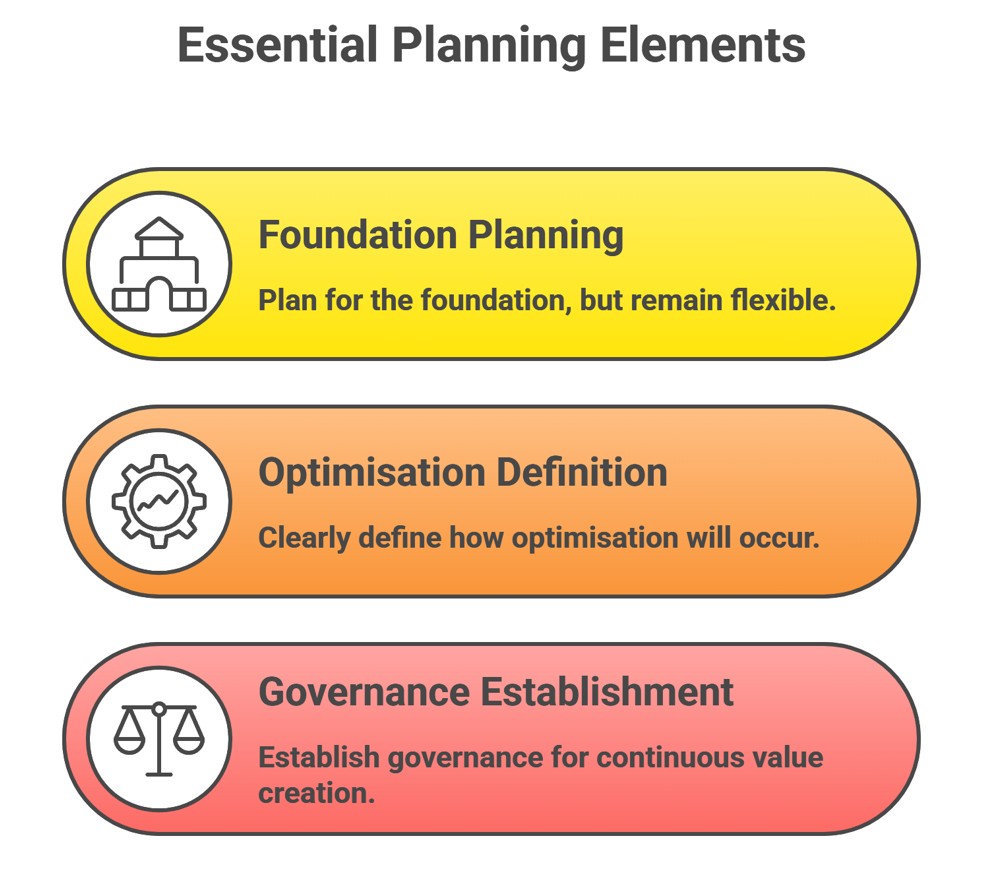
1. Plan for Foundation — But Don’t Anchor to It
Yes, go-live matters.
But it is only the starting point.
Design decisions should consider:
- Future integrations
- Scalability
- Data structure for reporting
- Long-term operating model
2. Define How Optimisation Will Happen
Before go-live, organisations should already know:
- Who owns process improvement
- How workflows will be reviewed and enhanced
- How users will be supported and trained over time
- How insights will be generated and used
Optimisation does not happen organically.
It requires structure.
3. Establish Governance for Continuous Value
This is the most critical and most neglected element.
Organisations must define:
- Who owns capability development
- How decisions about changes are made
- How value is measured
- How continuous improvement is prioritised
Without governance, ERP stagnates.
With governance, ERP evolves.
The Deeper Issue
This is not a technology problem.
It is a structural one.
Most organisations have:
- IT to manage systems
- Business to run operations
But no clear ownership of:
Improving how the organisation works over time.
This is the missing discipline.
And ERP exposes it more than anything else.
Final Thought
ERP does not fail because of software.
It under-delivers because organisations treat it as an endpoint.
But ERP is not the destination.
It is the platform.
The real question is:
What capability will you build on top of it?