Most organisations believe they are well structured.
They can clearly identify how work is divided, who owns what, and how decisions are made.
But this clarity is only partial.
In reality, every organisation operates across three distinct disciplines—yet only two are formally recognised.
The Three Disciplines of an Organisation:
| Discipline | What it Focuses On | Ownership Clarity |
| IT | Systems and technology | Clear |
| Business | Operations and service delivery | Clear |
| Capability Development | Improvement of how the organisation works | Unclear / fragmented |
This missing clarity is not a minor gap.
It is the reason why organisations invest heavily in systems, projects, and change—
yet struggle to get materially better.
IT — The Discipline of Stability and Control
Why IT exists
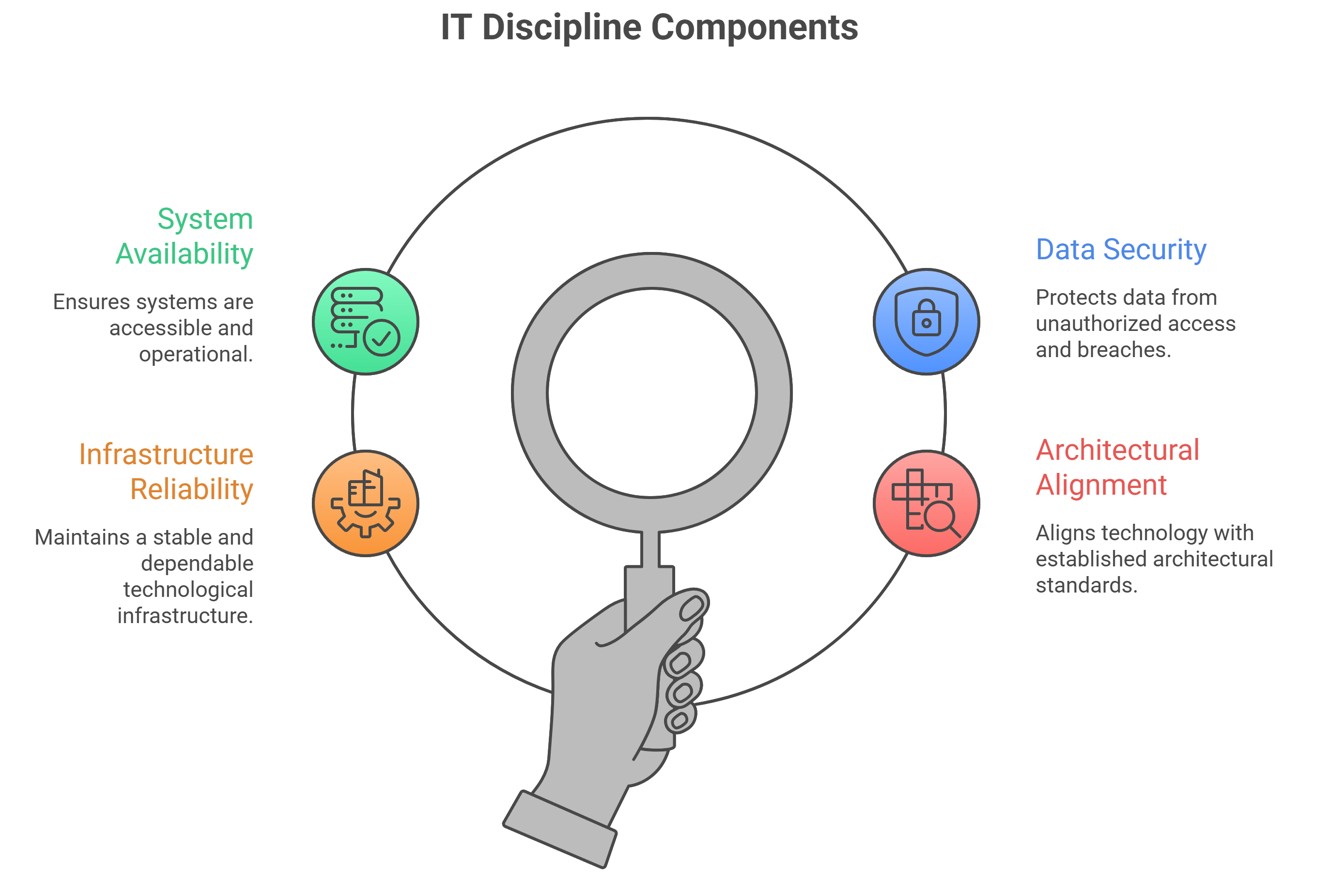
IT exists to enable and sustain the technology environment of the organisation.
It ensures:
- Systems are available
- Data is secure
- Infrastructure is reliable
- Technology aligns with architectural standards
This is a control function.
How IT sees the organisation
IT views the organisation through a systems lens.
It focuses on:
- Platforms
- Integrations
- Architecture
- Environments
Its success is defined by:
- Stability
- Reliability
- Controlled change
If systems are implemented and running as designed, IT has succeeded.
Where IT stops
IT does not own:
- Whether work becomes easier
- Whether processes improve
- Whether value is realised
From its perspective, a system can be successful—even if the organisation struggles to use it effectively.
Because IT is designed to run systems—not redesign work.
Business — The Discipline of Execution and Outcomes
Why Business exists
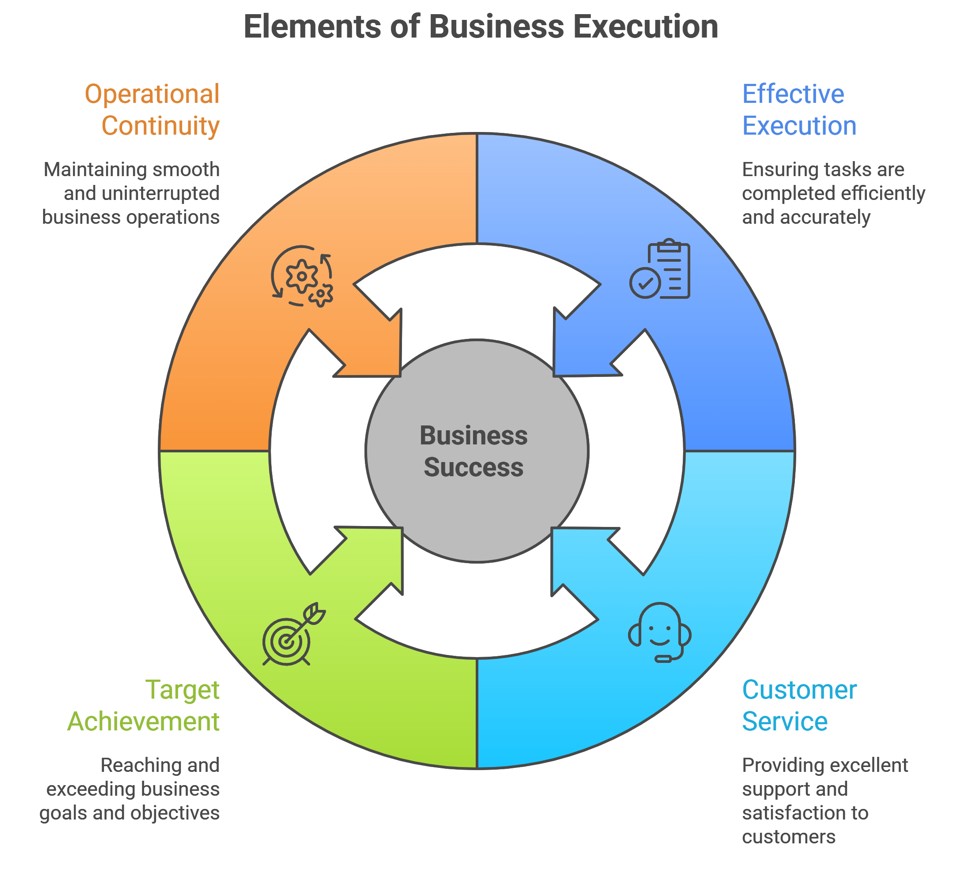
Business exists to deliver services and execute operations.
It ensures:
- Work gets done
- Customers are served
- Targets are met
- Operations continue
This is an execution function.
How Business sees the organisation
Business views the organisation through an outcomes lens.
It focuses on:
- Tasks
- Outputs
- Deadlines
- Customer needs
Its success is defined by:
- Delivery
- Responsiveness
- Throughput
If work is getting done, Business is succeeding.
Where Business stops
Business does not own:
- Structural design of processes
- System alignment
- Long-term capability uplift
Instead, it adapts:
- Creates workarounds
- Solves problems locally
- Prioritises immediate delivery
Because Business is designed to deliver within constraints—not redesign them.
Capability Development — The Discipline That Should Exist
There is a third type of work happening in every organisation.
It sits between IT and Business—but is owned by neither.
Why Capability Development exists
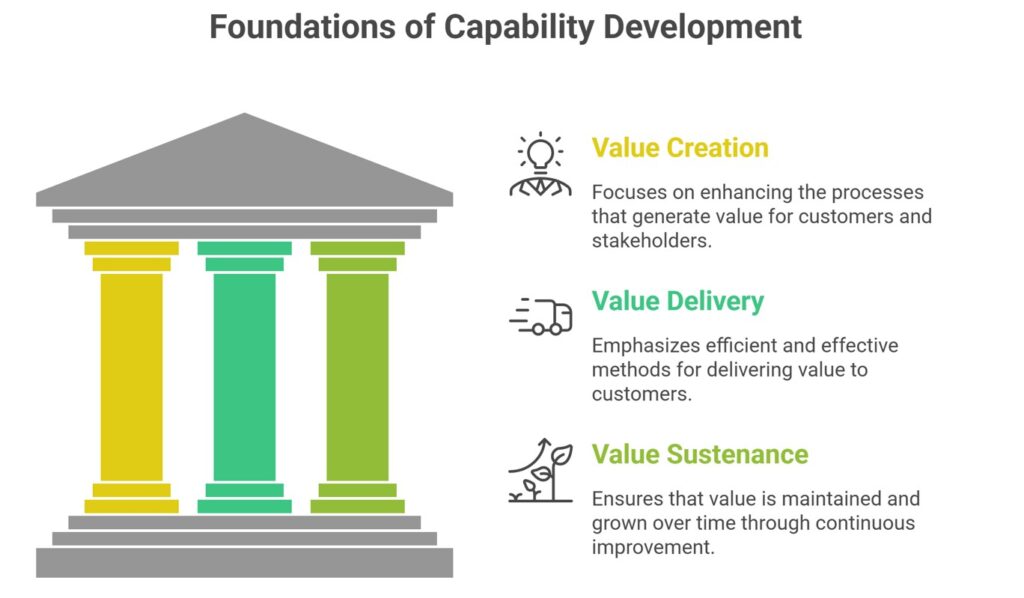
Capability Development exists to:
Systematically improve how value is created, delivered, and sustained.
It connects:
- Strategy to execution
- Systems to processes
- People to outcomes
This is a design and improvement function.
What Capability Development is responsible for
- Understanding business strategy in operational terms
- Developing architecture and roadmaps for capability uplift
- Designing processes, systems, data, and roles as an integrated whole
- Governing system implementations from a value perspective
- Driving continuous improvement
- Ensuring adoption, training, and behavioural change
- Coordinating across IT and Business
- Embedding improvements into operations
Its focus is:
Transformation, alignment, and long-term performance
How Capability Development sees the organisation
It views the organisation as a system of value creation.
It asks:
- How does work flow end-to-end?
- Where is value lost or delayed?
- Are systems, processes, and roles aligned?
- Are we improving over time—or repeating effort?
The Structural Reality
Here is the critical insight:
IT runs systems.
Business runs operations.
No one owns how the organisation improves.
Capability Development work still happens.
But it is fragmented across:
- IT-led system implementations
- Business-led process changes
- PMO-led coordination
- Consultant-led interventions
Each contributes.
No one integrates.
The Consequence: Fragmentation
When Capability Development is not formalised as a discipline, predictable patterns emerge.
1. Misalignment between systems and operations
Systems are implemented based on technical or vendor logic.
Operations adapt around them.
Alignment is assumed—but rarely achieved.
2. Poor adoption and wasted investment
Training is delivered.
Systems go live.
But:
- Users revert to old ways
- Workarounds emerge
- Value remains unrealised
3. Continuous reinvention
The same problems reappear:
- In different departments
- In different systems
- In different projects
Because root causes are never structurally addressed.
4. Fragmented decision-making
Without a unifying discipline:
- Decisions are inconsistent
- Standards vary
- Ownership is unclear
Outcomes depend on individuals—not design.
Why This Is Hard to See
This problem persists because it is structurally invisible.
- IT reports system success
- Business reports operational success
- Projects report delivery success
All signals appear positive.
But none answer the fundamental question:
Are we improving how the organisation works?
The Strategic Implication
Capability Development cannot remain:
- A project
- A temporary transformation effort
- A loosely defined initiative
It must become a formal discipline.
This requires:
- Clear ownership
- Defined architecture
- Structured roadmap
- Integrated governance across IT and Business
Link to the Broader Governance Problem
This is not an isolated issue.
It directly reflects deeper structural gaps:
- Fragmentation is a symptom of unclear executive standards
- Lack of ownership is a governance blind spot
- Absence of discipline leads to predictable underperformance
This is where most ERP and transformation programs fail—not in execution, but in design.
Bottom Line
Most organisations are not failing.
They are operating exactly as designed:
- IT optimises systems
- Business optimises delivery
But no one is accountable for ensuring the organisation actually improves.
And what is not clearly owned—
will always remain fragmented.
If you can see this clearly, you are already ahead of most organisations.
Because the first step is not fixing the problem.
The first step is making it visible.