Why structure, systems, and behaviour rarely align?
The Illusion of a Well-Designed Organisation
Most organisations appear structured.
They have:
- Defined organisational charts
- Documented processes
- Implemented systems
On the surface, everything suggests control.
Workflows exist. Systems are in place. Responsibilities are assigned.
And yet, beneath this apparent order, a quieter reality exists.
- Systems are used—but not always as intended
- Processes are defined—but inconsistently followed
- Decisions are made—but not always through formal channels
This is where most leaders begin to feel the gap.
Not because the organisation lacks effort,
but because it lacks clarity on how it truly operates.
Seeing the Organisation as It Is
To understand this gap, it helps to step back and observe the organisation differently.
Every organisation operates across three layers:
- Structure
- System
- Behaviour
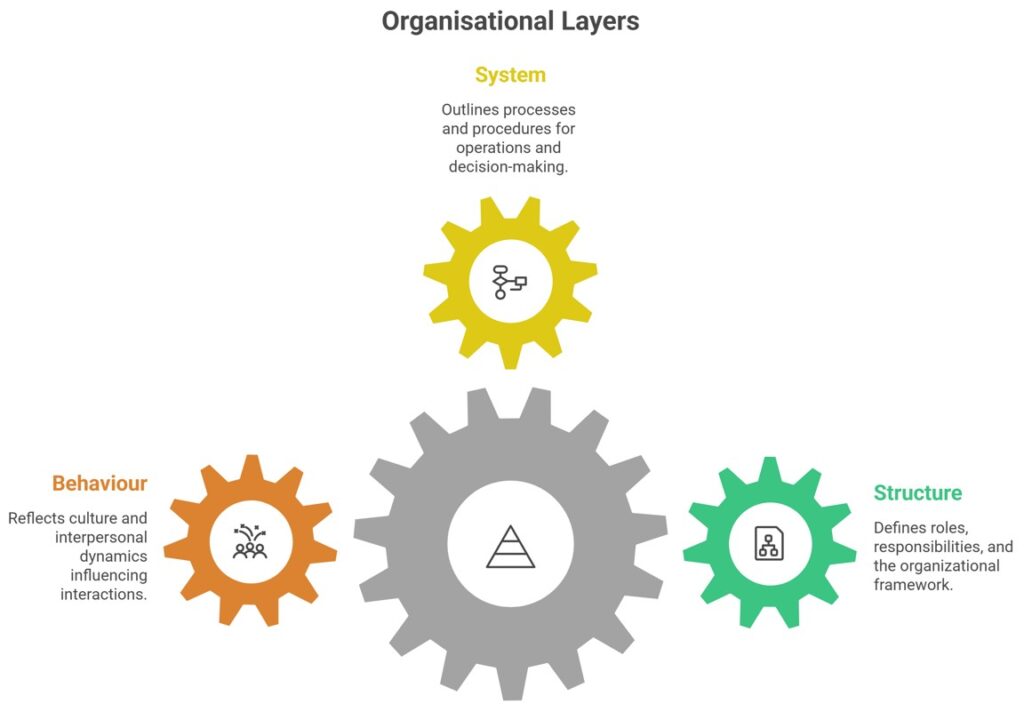
These layers are always present.
But they are not equally visible.
And more importantly, they are rarely aligned.
Structure — The Intended Design
Structure is where organisations begin.
It defines:
- Roles and responsibilities
- Reporting lines
- Policies and procedures
- Governance frameworks
Structure represents intent.
It answers the question:
How should this organisation work?
A simple example
A procurement process is designed with:
- Defined approval limits
- Clear escalation paths
- Documented policies
On paper, everything is logical.
Responsibilities are clear.
Controls are defined.
The organisation, at this level, appears well designed.
System — The Operational Expression
To bring structure to life, organisations implement systems.
These include:
- ERP platforms
- Workflow tools
- Data and reporting systems
Systems translate structure into activity.
They answer the question:
How does work move through the organisation?
Continuing the example
The procurement process is now embedded in an ERP system.
- Requests are logged
- Approvals are routed
- Transactions are recorded
From a system perspective, everything is functioning.
The workflow exists.
The process is digitised.
The organisation, at this level, appears controlled.
Behaviour — The Lived Reality
But there is a third layer.
This is where the organisation truly operates.
Behaviour is:
How people interact, decide, and act—based on both written and unwritten rules.
It includes:
- Informal practices
- Workarounds
- Incentives and pressures
- Local decision-making
Behaviour answers the question:
How does work actually get done?
The reality behind the example
In practice:
- A manager is called directly to fast-track approval
- Purchase orders are split to stay within limits
- Approvals are completed after the fact
From the outside:
- The system shows compliance
- The structure appears intact
But the lived reality is different.
The organisation is functioning—
but not as designed.
Where Misalignment Begins
Most organisations assume a simple flow:
Structure → System → Outcomes
Design the structure.
Implement the system.
Achieve the outcome.
But this assumption misses a critical truth.
In reality:
Behaviour → shapes system usage → determines outcomes
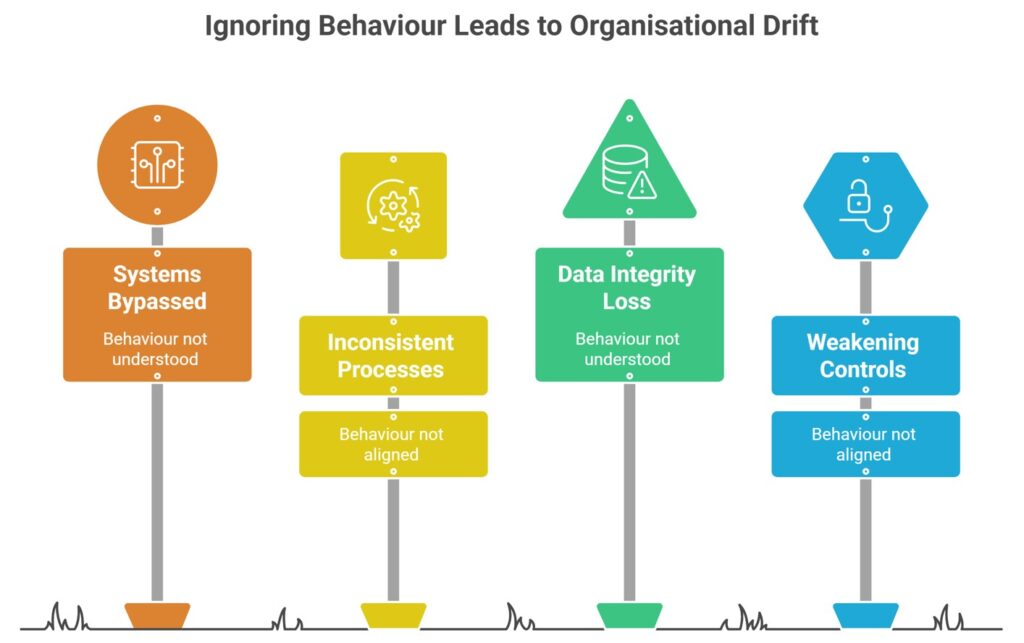
The Consequence of Ignoring Behaviour
When behaviour is not understood or aligned:
- Systems are bypassed
- Processes become inconsistent
- Data loses integrity
- Controls weaken over time
The organisation continues to operate—but begins to drift.
Why This Problem Remains Invisible
One of the reasons this issue persists is that each layer tells a different story.
IT sees system performance
The system is implemented.
Workflows are running.
Data is being captured.
From this perspective, the organisation is functioning.
Business sees output
Work is getting done.
Customers are being served.
Deadlines are being met.
From this perspective, the organisation is delivering.
Behaviour sits in between
It is rarely measured.
Rarely discussed.
Rarely owned.
Workarounds become normal.
Shortcuts become accepted.
Unwritten rules take over.
A Simple Way to Understand It
Think of an organisation like a road system.
- Structure is the road rules
- System is the roads and signals
- Behaviour is how people actually drive
You can have:
- Perfect rules
- Well-designed roads
But if behaviour does not align—the outcome will not match the design.
Where Most Transformation Efforts Fall Short
Most transformation efforts focus on:
- Redesigning structure
- Implementing systems
Very few address:
How behaviour must change to make both effective?
This is why we see repeated patterns:
- ERP systems go live, but adoption is partial
- Process redesigns are documented, but not sustained
- Change initiatives start strong, but fade over time
The organisation changes—but does not improve in a lasting way.
The Missing Link
To bring these layers together, organisations need to recognise something fundamental:
Improvement does not happen through structure or systems alone.
It requires alignment across all three layers.
This is where Capability Development becomes critical.
Not as a project.
Not as a temporary initiative.
But as a discipline responsible for:
- Designing how work should happen
- Ensuring systems support that design
- Aligning behaviour to sustain it
Closing Thought
Most organisations are not failing.
They are simply incomplete in how they understand themselves.
They manage what is visible:
- Structure
- Systems
But overlook what is decisive:
- Behaviour
And what is not clearly seen—cannot be properly managed.
If you can begin to see these three layers together, you start to understand why:
- Well-designed organisations struggle.
- Well-implemented systems underperform.
- And well-intentioned change does not last.
Because an organisation is not defined by what is designed—but by what is consistently done.